BAS Season Doesn't Have to Mean Burnout
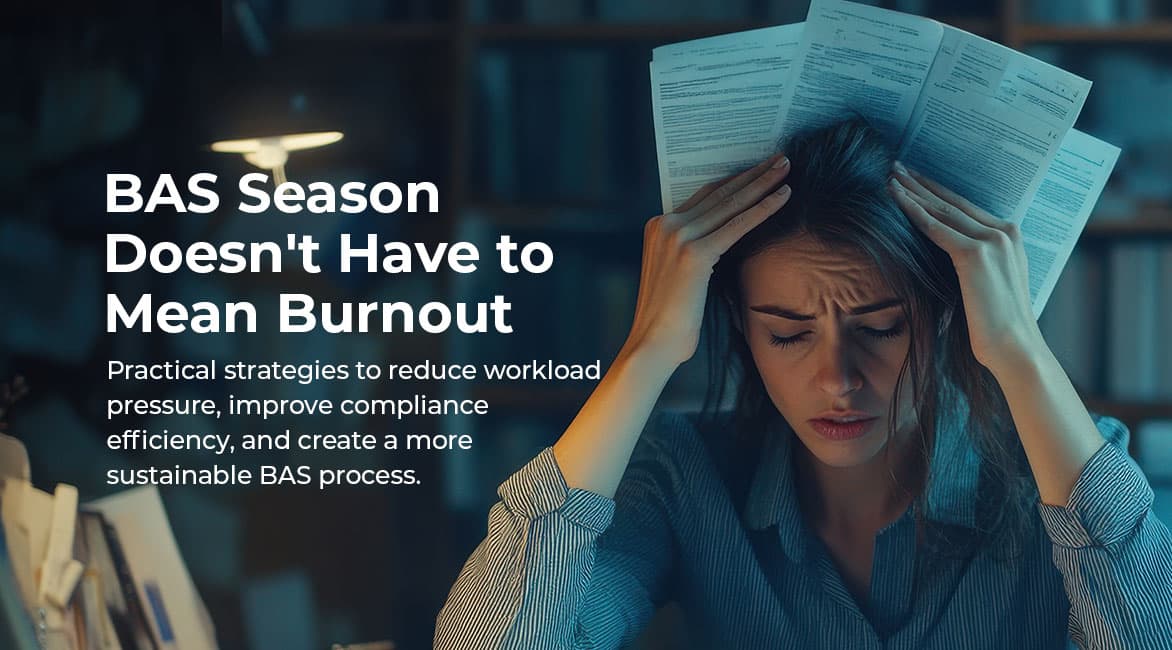
Every Quarter, the Same Rush. Does BAS Season Have to Be This Way?
The pattern is familiar across accounting firms of all sizes.
The quarter begins with good intentions. Client work is progressing steadily, reconciliations are underway, and BAS deadlines still seem comfortably distant. Then, almost overnight, everything changes. Client records start arriving in batches. Outstanding queries suddenly become urgent. Review queues grow longer. Senior accountants find themselves pulled into routine processing tasks. What looked manageable a few weeks earlier now feels like a race against the clock.
The pressure isn't merely anecdotal. Accountant burnout has become a growing industry concern. Research from FloQast found that 99% of accounting and finance professionals reported experiencing some level of burnout, highlighting the growing operational and workforce challenges facing firms managing recurring compliance workloads.
Many Australian firms are experiencing this pressure at a time when finding and retaining skilled accounting professionals remains increasingly difficult. A recent survey by Chartered Accountants Australia and New Zealand (CA ANZ) identified Australia-wide shortages of Taxation Accountants, External Auditors, and General Accountants, making workload and capacity management even more critical during peak compliance periods.
The frustrating part is that BAS deadlines themselves aren't a surprise. According to the Australian Taxation Office (ATO), quarterly BAS lodgement dates follow a predictable reporting schedule throughout the year, giving firms ample opportunity to plan resources, workflows, and compliance activities.
Yet many firms still find themselves battling the same challenges:
- Last-minute document collection
- Reconciliation bottlenecks
- Review backlogs
- Overtime hours
- Capacity constraints
- Compliance pressure
This raises an important question.
If BAS season is entirely predictable, why does it continue to create so much disruption?
The answer often has less to do with BAS compliance itself and more to do with how work accumulates around the deadline. In many cases, BAS season doesn't create operational problems. It simply exposes weaknesses that have been building beneath the surface for weeks or even months.
Effective BAS season workload management is about addressing those weaknesses before the deadline arrives. Firms that do this well aren't necessarily larger or better staffed. They simply operate with stronger systems, more proactive planning, and a clearer approach to managing recurring compliance workloads.

Why BAS Season Creates So Much Pressure for Accounting Teams
For many firms, BAS season feels hectic because multiple compliance obligations converge within a relatively short period. However, while deadlines often receive the blame, the deadline itself is rarely the root cause of the pressure.
The Challenge Isn't the Deadline
Business Activity Statements are an essential part of Australia's tax and compliance framework. Whether clients lodge monthly, quarterly, or annually, accounting teams must ensure accuracy, completeness, and timeliness at every stage of the process.
The challenge is that BAS work rarely exists in isolation.
Before a BAS can be prepared and reviewed, firms often need to complete a range of supporting activities, including:
- Bank reconciliations
- GST coding reviews
- Payroll reconciliations
- Transaction categorisation
- Data validation
- Client query resolution
Each task may seem manageable on its own. When multiplied across dozens or hundreds of clients, however, the workload can expand rapidly.
As BAS due dates approach, even small delays can begin to compound. Incomplete information that might have been a minor issue earlier in the quarter suddenly becomes a critical roadblock. Teams find themselves spending valuable time chasing records, resolving discrepancies, and responding to urgent client requests instead of focusing on higher-value work.
Where the Pressure Really Comes From
When firms examine their busiest BAS periods, they often discover that the stress isn't being caused by the lodgement process itself. The pressure typically originates from several recurring issues:
Late client documentation
Many firms receive a significant portion of required records close to the deadline, leaving less time for review and exception handling.
Incomplete bookkeeping
Unresolved transactions, overdue reconciliations, and uncleared balances often surface during BAS preparation, creating additional work when capacity is already stretched.
GST coding inconsistencies
Errors in GST treatment may require investigation and correction before BAS reporting can proceed confidently.
Resource constraints
Even highly efficient teams have limits. When multiple deadlines converge, available capacity can quickly become exhausted.
Growing compliance expectations
Clients increasingly expect faster turnaround times, deeper insights, and higher levels of support, all while compliance standards continue to evolve.
The result is a workload surge that places considerable strain on accounting teams.
The firms that manage BAS season most effectively recognise that the solution isn't simply working longer hours. Instead, they focus on reducing the amount of work that accumulates at the deadline in the first place.
Why BAS Season Exposes Workflow Weaknesses
One of the most common misconceptions about BAS season is that it creates operational problems.
In reality, BAS season often reveals problems that already exist.
When workloads are relatively stable, firms can usually absorb small inefficiencies without experiencing major disruption. A delayed reconciliation here or an unresolved transaction there may not seem particularly significant at the time. But once BAS deadlines approach, those same issues tend to resurface simultaneously.
Workflow Issues Rarely Begin at Quarter-End
The warning signs often appear weeks before BAS preparation begins.
Examples include:
- Transaction coding delays
- Outstanding client queries
- Missing source documentation
- Inconsistent bookkeeping processes
- Unclear task ownership
- Delayed review cycles
Individually, none of these issues may appear serious.
Collectively, however, they create a backlog that grows larger as the quarter progresses.
By the time BAS preparation starts, teams are no longer dealing solely with the current compliance period. They are also dealing with unresolved work carried forward from earlier weeks.
Small Delays Become Major Bottlenecks
A common pattern in many firms looks something like this:
A reconciliation is delayed by a few days.
The reconciliation delay prevents GST validation.
The GST review postpones BAS preparation.
The BAS review gets pushed closer to the deadline.
Senior staff then become involved to resolve issues that could have been identified much earlier.
What started as a relatively minor delay eventually impacts multiple stages of the workflow.
When repeated across numerous clients, these bottlenecks can significantly affect productivity and turnaround times.
Common BAS Season Bottlenecks
The most frequent workflow constraints include:
- Chasing missing client information
- Reconciliation backlogs
- Manual data entry activities
- GST review delays
- Payroll adjustments identified late in the process
- Senior accountants spending time on routine processing tasks
- Limited review capacity during peak periods
Many firms initially view these challenges as staffing problems. However, they are often workflow problems first.
That's an important distinction because adding more people to an inefficient process does not necessarily remove the bottleneck.
The firms that experience less BAS-related stress tend to focus on improving process efficiency throughout the quarter rather than attempting to resolve everything during the final weeks before lodgement.
The Hidden Cost of Operating in Deadline Mode
When BAS season becomes a recurring rush, the impact extends far beyond a few late nights in the office.
Most firms focus on meeting the immediate deadline, but operating in a constant state of catch-up often creates hidden costs that accumulate over time.
Burnout Is Only the Beginning
During peak compliance periods, teams may temporarily accept longer hours and increased workloads. The problem arises when this becomes the norm every quarter.
Over time, firms often experience:
- Lower employee engagement
- Increased stress and fatigue
- Greater risk of errors
- Reduced job satisfaction
- Higher staff turnover
What starts as a workload issue can quickly become a people issue.
The Impact on Client Service
Deadline mode doesn't just affect internal teams. Clients feel it too.
When workloads spike unexpectedly, firms often have less capacity to:
- Respond quickly to client queries
- Deliver proactive advice
- Identify tax planning opportunities
- Focus on relationship building
Instead of driving value, teams spend most of their time reacting to urgent tasks.
The Real Opportunity Cost
Perhaps the highest cost is the work that never gets done.
Every hour spent fixing avoidable process issues is an hour that could have been invested in:
- Advisory services
- Business development
- Process improvement
- Team development
- Client growth initiatives
The most successful firms understand that reducing workload pressure is not simply about improving wellbeing. It is also about protecting profitability, service quality, and long-term growth.
What High-Performing Firms Do Differently
The firms that navigate BAS season most effectively aren't necessarily the firms with the largest teams.
More often, they have established processes that prevent work from accumulating near key deadlines.
They Keep Books BAS-Ready Throughout the Quarter
Rather than treating BAS preparation as a quarter-end activity, leading firms adopt a continuous approach.
Key practices include:
- Regular bank reconciliations
- Timely transaction coding
- Ongoing GST reviews
- Prompt resolution of client queries
By addressing issues as they arise, they reduce the amount of cleanup work required later.
They Standardise Their Workflows
Consistency creates efficiency.
Many high-performing firms use standardised processes covering:
- Data collection
- Bookkeeping reviews
- BAS preparation
- Quality control
- Final approval
When everyone follows the same process, work moves more smoothly through the pipeline and bottlenecks become easier to identify.
They Automate What Doesn't Require Expertise
Highly trained accountants add the most value when analysing information and advising clients, not performing repetitive administrative tasks.
Common areas for automation include:
- Client reminders
- Workflow tracking
- Document requests
- Data collection
- Task management
This allows teams to focus their expertise where it matters most.
They Plan Capacity Before It Becomes a Problem
One of the biggest differences between stressed firms and well-prepared firms is visibility.
Leading firms actively monitor:
- Upcoming BAS volumes
- Team capacity
- Seasonal workload trends
- Potential resource gaps
This enables them to make adjustments before pressure reaches critical levels.
Four Habits of High-Performing BAS Teams
1. Prepare continuously, not quarterly.
2. Standardise workflows wherever possible.
3. Monitor workload trends early.
4. Build flexibility into resource planning.
These practices may seem simple, but together they can dramatically improve BAS season workload management.
How BAS Preparation Support Creates Capacity Without Increasing Headcount
Hiring additional staff is often the first solution firms consider when BAS workloads increase.
Unfortunately, recruitment can be expensive, time-consuming, and challenging in a competitive talent market. Even when firms find the right candidate, demand doesn't always justify a permanent hire throughout the year.
That's why many firms are exploring more flexible approaches to managing BAS-related workloads.
Why Capacity Has Become a Bigger Challenge
Many accounting practices are balancing:
- Growing client portfolios
- Increased compliance requirements
- Tight turnaround expectations
- Ongoing recruitment challenges
As a result, BAS season can place significant strain on existing teams.
The objective is no longer simply getting the work done. It is getting the work done without exhausting internal resources.
What BAS Preparation Support Can Help With
Flexible BAS processing support can assist with a range of recurring tasks, including:
- Transaction coding
- Bank reconciliations
- GST reviews
- Working paper preparation
- Draft BAS preparation
- IAS processing support
By shifting routine and repeatable work away from core team members, firms can improve capacity without sacrificing quality or turnaround times.
Creating a More Scalable Operating Model
The most effective support models do more than reduce workload.
They help firms:
- Manage seasonal demand fluctuations
- Improve workflow consistency
- Reduce overtime pressure
- Strengthen compliance processes
- Support business growth
This is particularly valuable during predictable workload peaks such as BAS season.
Rather than scrambling for resources every quarter, firms can build a more flexible operating model that expands and contracts as workload demands change.
The result is a more sustainable approach to compliance delivery and a more resilient foundation for future growth.

A Practical BAS Season Workload Management Framework
The most effective way to reduce BAS season pressure is to stop treating the deadline as the starting point.
Instead, leading firms distribute work across the entire compliance cycle. This creates better visibility, reduces bottlenecks, and gives teams more time to identify and resolve issues before they become urgent.
A Simple Framework for Managing BAS Workloads
|
Timeline |
Priority Activity |
Desired Outcome |
|
30 Days Before |
Gather records and assign workload |
Early visibility of potential issues |
|
21 Days Before |
Complete reconciliations |
Fewer review bottlenecks |
|
14 Days Before |
Prepare draft BAS reports |
More time for corrections |
|
7 Days Before |
Conduct final reviews |
Improved compliance accuracy |
|
Deadline Week |
Lodge and monitor |
Minimal last-minute pressure |
Why This Approach Works
Many firms unintentionally compress several weeks of work into the final days before lodgement.
The result is predictable:
- Teams rush through reviews
- Senior staff become overloaded
- Turnaround times suffer
- Stress levels increase
Spreading key activities across the reporting cycle helps eliminate this pattern.
For example, if reconciliations are completed three weeks before the deadline and GST reviews are conducted two weeks before lodgement, any issues can be identified while there is still adequate time to resolve them.
Focus on Progress, Not Perfection
BAS season rarely becomes overwhelming because of one major issue.
More often, it is dozens of small delays that accumulate over time.
A structured workload management framework ensures those small issues are addressed consistently before they have an opportunity to disrupt the entire process.
The objective is simple: make deadline week about lodgement, not preparation.
Signs Your Current BAS Process Has Reached Its Limit
Every accounting practice experiences busy periods.
However, there is a difference between a seasonal increase in workload and a process that is no longer sustainable.
If the same operational challenges appear every quarter, the issue may not be BAS season itself. It may be the firm's current operating model.
Common Warning Signs
Overtime Becomes Expected
Occasional extra effort is normal.
When late nights become a recurring part of every BAS cycle, it often indicates a capacity or workflow issue rather than a workload issue.
Review Queues Keep Growing
If BAS work consistently waits for review during peak periods, it may be a sign that processes are not scaling efficiently.
Senior Staff Spend Too Much Time Processing
Experienced accountants should focus on reviewing work, advising clients, and supporting growth.
When they spend the majority of BAS season completing routine processing tasks, valuable capacity is being lost.
Client Service Begins to Suffer
Watch for indicators such as:
- Slower response times
- Missed deadlines
- Delayed projects
- Reduced advisory capacity
These are often early signs that existing systems are under strain.
Growth Can Magnify Existing Problems
Many firms assume these challenges will resolve themselves once BAS season passes.
In reality, business growth often amplifies inefficiencies.
More clients create more transactions, more reviews, and more compliance requirements.
Without stronger processes and scalable support structures, today's manageable bottleneck can quickly become tomorrow's major operational constraint.
Recognising these warning signs early allows firms to make proactive changes before burnout, turnover, or declining service quality become serious business risks.
Build a More Predictable, Profitable and Sustainable BAS Season
BAS season will always be busy. That is the nature of recurring compliance work.
What it shouldn't be is chaotic.
Firms that consistently manage BAS periods successfully tend to share the same characteristics. They maintain BAS-ready records throughout the quarter, standardise workflows, forecast capacity early, and avoid allowing work to accumulate around key deadlines.
The result is more than just smoother lodgements.
It means less pressure on teams, stronger compliance outcomes, better client experiences, and greater capacity to support business growth.
When BAS season is approached as an operational process rather than a quarterly emergency, burnout becomes far less likely and sustainable performance becomes far more achievable.
Struggling to Keep Up With BAS Deadlines Without Overloading Your Team?
Explore how PABS Australia helps accounting firms increase BAS processing capacity, improve turnaround times, and maintain compliance accuracy during peak workload periods.
Frequently Asked Questions
1. Why do some accounting firms experience more BAS season pressure than others?
The difference is rarely the deadline itself. Firms that struggle during BAS season often face workflow bottlenecks such as delayed reconciliations, inconsistent processes, late client information, and limited capacity planning. Firms that spread BAS-related work throughout the quarter typically experience less pressure and fewer last-minute issues.
2. How far in advance should BAS preparation begin?
Ideally, BAS preparation should be an ongoing process rather than a quarter-end task. Regular bookkeeping reviews, reconciliations, and GST checks throughout the reporting period help reduce workload spikes and improve compliance accuracy.
3. What are the most common causes of BAS reporting delays?
Late client documentation, reconciliation backlogs, GST coding errors, unresolved payroll adjustments, and manual data processing are among the most common factors that slow BAS reporting and increase deadline pressure.
4. When should a firm consider external BAS processing support?
If overtime becomes routine, review queues continue growing, or BAS workloads begin affecting client service and growth initiatives, it may be time to explore additional support capacity.
5. Can outsourcing BAS-related work improve compliance outcomes?
When supported by well-defined processes and qualified accounting professionals, outsourced BAS preparation and bookkeeping support can help improve consistency, turnaround times, workload distribution, and overall compliance efficiency.
Published on:

Author
Martin Conboy
Martin is well recognised as one of the leading voices of the outsourcing industry and its role in facilitating outsourcing success throughout the Asia Pacific. Martin was voted into the top five most influential and respected people in the global call centre outsourcing industry in November 2014. An experienced international executive with demonstrated commercial insight, and strong interpersonal and networking skills within the outsourcing, recruitment, customer service, contact centre, logistics and telecommunications industries in Australia.
Listen Exclusive Podcast On